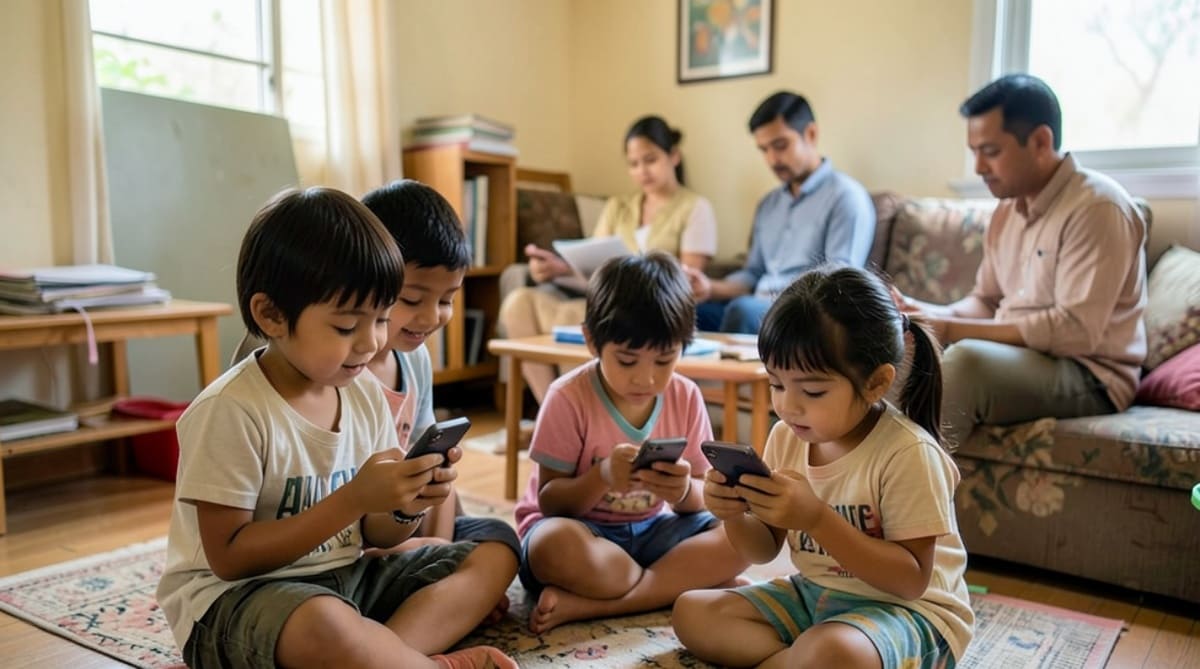
Is the Smartphone in Your Child’s Hand a Tool or a Trap? A Guide to Protecting the Next Generation
Excessive smartphone usage is directly linked to childhood anxiety, sleep deprivation, and a dangerous erosion of cognitive focus and attention spans. To protect developing minds, parents must move with urgency to delay personal device ownership and replace screen time with physical play and reading.
By Imrana
New Delhi | June 10, 2026
Reclaiming Childhood in the Digital Age
The sight of a toddler navigating a touchscreen with more ease than they speak is no longer an anomaly—it is becoming the norm. While many parents view smartphones as convenient tools for entertainment or even feeding, evidence suggests these devices are doing measurable, lasting damage to young minds and bodies. India’s Economic Survey 2025-26 has officially linked high smartphone usage in children to increased vulnerability to online dangers and severe health problems.
The Biological Cost of the Screen
The physical consequences of early screen exposure are arriving faster than expected. Pediatricians are reporting alarming rates of myopia (short-sightedness), as a child’s developing eye is not built for hours of fixed focus on a bright, close-range screen. Furthermore, the blue light emitted by these devices suppresses melatonin, leading to chronic sleep deprivation. A child who cannot sleep cannot concentrate, and a child who cannot concentrate cannot learn, creating a damaging chain reaction in their education.
A smartphone is not just a device; it is a sophisticated machine engineered to capture a child’s attention at the expense of their developing brain.
The Cognitive Erosion
Beyond physical health, smartphones are interrupting the foundation of cognitive development. Skills such as sustained focus, deep reading, and patient problem-solving are built through effort and play. However, the “instant reward” nature of 15-second videos and autoplay notifications trains the young brain to expect stimulation without effort. This often results in children who are unable to engage with anything that requires depth or patience.
The “Rabbit Hole” of Online Content
Parents often take comfort in the belief that their children are only watching cartoons or playing simple games. However, these platforms use sophisticated psychological mechanisms, similar to those in casinos, to maximize watch time. Algorithms can lead a child from innocent content to violent material or unmonitored gaming chats with strangers in just a few clicks. Because children are not yet equipped to recognize online predators, the responsibility for their safety falls entirely on the adults in their lives.
Delaying personal smartphone ownership is the single highest-return on investment a parent can make in a child’s intellectual and social life.
A Global Call to Action
Governments worldwide are beginning to treat smartphone addiction as a public health crisis. In 2026, the Indian state of Karnataka announced a ban on social media for children under 16, following similar legislative bans in Australia and restrictions in France, Spain, and Finland. Even technology leaders at OpenAI have called for international safety standards to protect young people from the very products they create.
How Parents Can Lead the Change
The most effective strategy for parents is simply to delay. A child does not need a personal smartphone at age seven or ten; they need conversation, physical books, and the experience of boredom that sparks creativity. When technology is introduced, it should be a shared family tool kept in common spaces with clear limits, such as “no phones at mealtimes”. By replacing screens with physical books, parents can help rebuild the focus and empathy that digital devices erode.
Childhood does not offer a second chance. The phone can wait, but our children’s development cannot.
The full version of this article was originally published on our RMN News site.
Writer Imrana is a student specializing in multiple domains such as business, trade, education, technology, entertainment, and politics.
She also produces Imrana’s Insight podcast program on diverse topics and Imrana’s Tech Talk podcast program on tech applications.
You can click here to read more articles by Imrana. You can also click here to know more about Imrana’s editorial and humanitarian work.
Imrana: LinkedIn Profile