New OpenAI Tools Help Students and Teachers Succeed in the AI Era
OpenAI has launched three specialized plugins for ChatGPT Edu and ChatGPT for Teachers to help students and educators master AI reasoning and multi-step projects. These tools focus on personalized learning, lesson planning, and academic research while maintaining strict data privacy and security for schools.
RMN Kids Technology Desk
New Delhi | August 6, 2026
As the new school year begins, OpenAI is transforming how artificial intelligence is used in the classroom. AI is shifting from a tool that simply answers questions to a system that can reason across context and help users carry out complex, multi-step academic work. To support this shift, three new education plugins have been introduced for ChatGPT Work and Codex, designed specifically for K–12 teachers, college educators, and college students.
Customized Support for Students and Teachers: These plugins act as packages of role-specific skills and workflows, allowing users to start using AI immediately without needing to learn complex prompting. By connecting to existing course materials, documents, and calendars, these tools provide a context-aware experience that helps turn ideas into reality.
- For College Students: The new student plugin helps create personalized learning experiences. Students can work with a guided tutor, practice difficult concepts, and generate study guides, flashcards, or quizzes from sources they choose. This approach uses learning science to build stronger study habits and a deeper understanding of the material.
- For K–12 Educators: Developed alongside teachers, this plugin helps plan lessons and create differentiated resources. It integrates with local academic standards to help teachers design interactive visuals and gain actionable insights while staying in control of all pedagogical decisions and grading.
- For College Faculty: This tool enables faculty to update syllabi, adapt materials for diverse learners, and package content for Learning Management Systems. It allows instructors to manage teaching and research tasks efficiently without recreating context for every project.
Closing the “Capability Overhang”: Research shows that while over 200 million young adults use ChatGPT weekly, many only use a fraction of its potential. This “capability overhang” represents a gap between what AI can do and how students currently use it. OpenAI aims to close this gap by providing structured access through ChatGPT Edu, which helps students develop more advanced patterns of use in analysis and calculation.
Also Read:
[ New Picture Book Makes Artificial Intelligence Fun and Accessible for Kids ]
Safety, Privacy, and Professional Training: OpenAI is committed to providing secure, institution-managed environments. ChatGPT Edu offers enterprise-level privacy and administrative controls, while ChatGPT for Teachers is free for verified U.S. K–12 educators and includes protections to support FERPA (Family Educational Rights and Privacy Act) requirements.
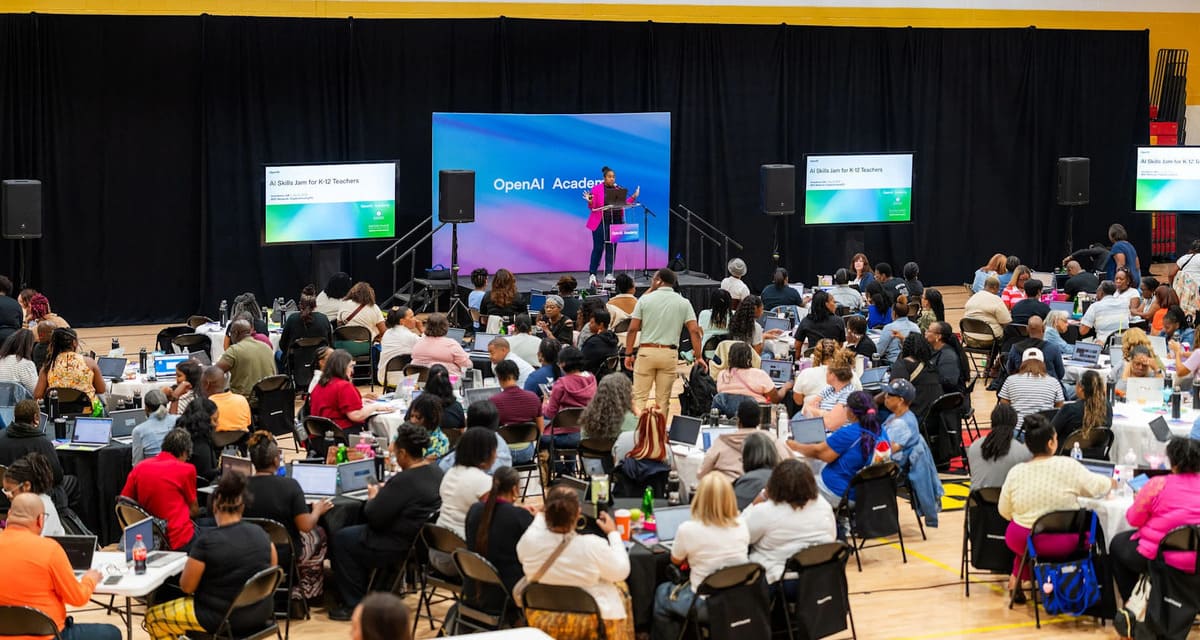
Beyond software, OpenAI is investing in people. Through a partnership with the American Federation of Teachers, the National Academy for AI Instruction aims to equip 400,000 K–12 educators with the skills to lead AI integration. Additionally, the OpenAI Academy and Student Collective are fostering communities where students and administrators can build practical skills for real-world challenges,. The ultimate goal is to help students develop agency—the ability to solve hard problems and turn their ideas into something real.